
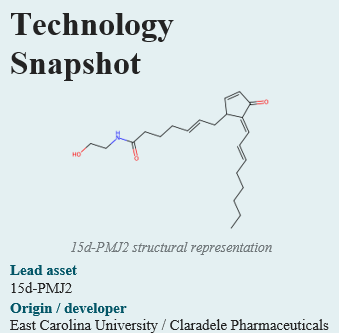
15-deoxy-Δ12,14-prostamide J2 (15d-PMJ2) is a preclinical small molecule being developed around an unusual dual-action concept: selectively drive tumor cells into lethal endoplasmic reticulum stress while triggering danger signals that can recruit an antitumor immune response. The initial commercial focus is melanoma, with additional public work in cutaneous and colorectal cancer models.
THE OPPORTUNITY
Melanoma and other solid tumors can escape both direct drug pressure and immune surveillance. 15d-PMJ2 is being positioned to address both problems in one chemical platform: cause tumor-biased cell death and convert that death into an immune-activating event.
THE INNOVATION
15d-PMJ2 is a J-series prostaglandin-ethanolamide (prostamide), a class of neutral lipids that include ophthalmologic agents. 15d-PMJ2 is produced from the metabolism of arachidonoyl ethanolamide (AEA, also known as anandamide) by cyclooxygenase-2 (COX-2). Because AEA is preferentially catabolized by fatty acid amide hydrolase (FAAH), supraphysiological levels of exogenous AEA are required for its metabolism to 15d-PMJ2. In preclinical studies, chemically synthesized 15d-PMJ2 preferentially induced apoptosis in tumorigenic melanoma and nonmelanoma skin-cancer cells compared with non-tumorigenic comparators. Mechanistic work links its activity to pleiotropic pharmacological effects on cytotoxic endoplasmic reticulum (ER) stress, PERK/calcium-mitochondrial signaling, and CHOP10/TRB3-mediated inhibition of Akt.(1,2,3) The ER stress pathway is known to be upregulated in melanoma(4) and is essential for the release of damage associated molecular patterns (DAMPs).
A separate melanoma study found tumor-selective exposure of calreticulin, ATP, HMGB1 and other DAMPs, followed by dendritic-cell activation, which is the biological rationale for an immunogenic-cell death strategy.(5)
WHY IT MATTERS
• One molecule supports two potential development pathways: directly triggering tumor cell death and promoting an immune response to the affected tissue.
• Tumor cell-biased ER stress biology could provide a differentiated therapeutic window, but this remains to be established clinically.
• A local skin-cancer entry strategy may offer accessible lesions, paired biopsies and rapid pharmacodynamic and visible clinical readouts before broader systemic development.
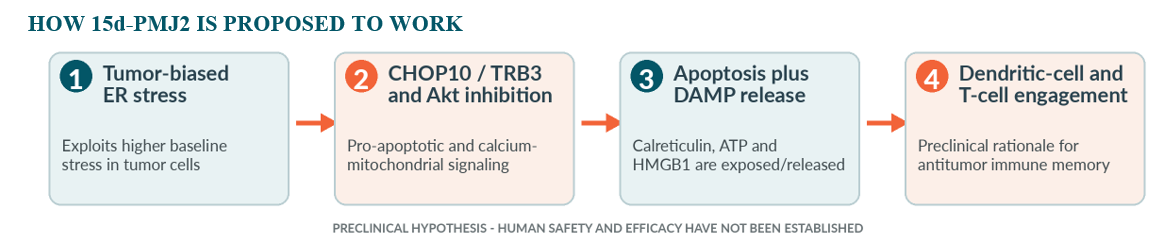
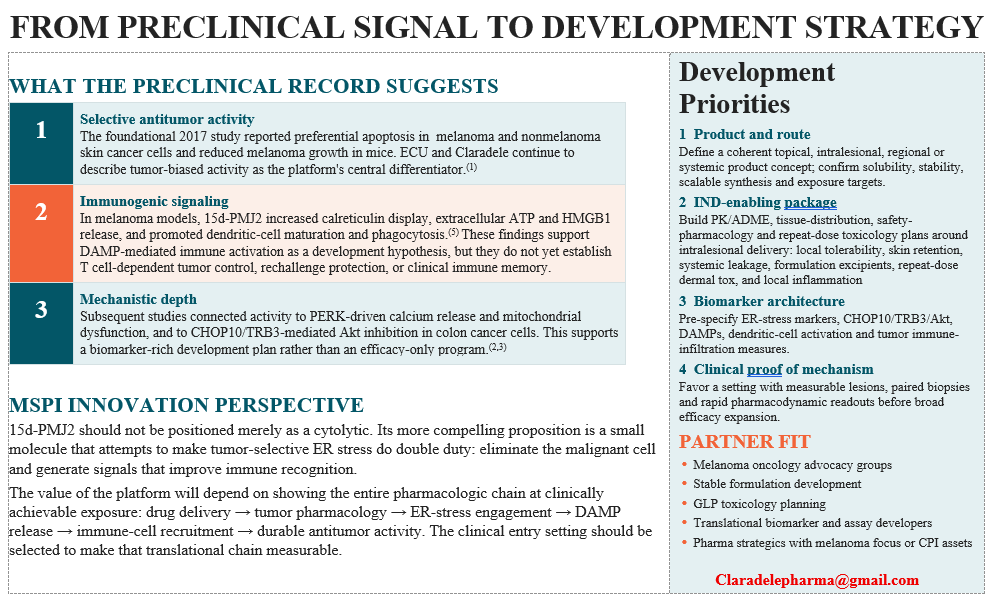
Practical Pointer: For immunogenic cell death programs, intrinsic killing of tumor cells is only the first proof point. The development package should strive to connect exposure to tumor stress, DAMP release, immune cell recruitment, and a durable antitumor immune response.

Legend:
Akt: A central pro‑survival kinase regulating cell growth, metabolism, and anti‑apoptotic pathways.
Arachidonoyl ethanolamide (AEA): Also known as anandamide; an endogenous lipid that produces biological effects by binding to cannabinoid receptors
Calreticulin: An ER chaperone that, when exposed on the cell surface, acts as an “eat‑me” signal to dendritic cells.
CHOP10: C/EBP Homologous Protein, also known as GADD153; a stress‑induced transcription factor involved in ER‑stress–mediated apoptosis.
COX-2: Cyclooxygenase-2; an inducible enzyme involved in prostaglandin and prostamide synthesis
DAMPs: Damage‑Associated Molecular Patterns; molecules released by stressed or dying cells that activate the immune system.
Endoplasmic Reticulum (ER) Stress: A cellular stress response triggered by misfolded or unfolded proteins, often leading to apoptosis and DAMP release
FAAH: Fatty Acid Amide Hydrolase; the primary enzyme that catabolizes anandamide, limiting its conversion to prostamides
HMGB1: High Mobility Group Box 1; a nuclear protein released during apoptosis that promotes dendritic-cell activation
IP3R: Inositol 1,4,5-trisphosphate receptor; regulates ER calcium release involved in stress signaling
mPTP: Mitochondrial permeability transition pore; a channel whose opening contributes to mitochondrial dysfunction and apoptosis
PERK: Protein kinase RNA-like ER kinase; a key ER-stress sensor that regulates calcium signaling and apoptotic pathways
Prostamide: A class of neutral lipids derived from anandamide via COX-2, including J-series prostamides such as 15d-PMJ2
TRB3: Tribbles Pseudokinase 3; inhibits Akt signaling and promotes apoptosis.
SELECTED SOURCES
1. Ladin DA, et al. Mol Cancer Ther. 2017;16:838-849. doi:10.1158/1535-7163.MCT-16-0484.
2. Ladin DA, et al. Oncotarget. 2022;13:1380-1396. doi:10.18632/oncotarget.28334.
3. Albassam H, et al. Front Pharmacol. 2023;14:1283677. doi:10.3389/fphar.2023.1283677.
4. Shi H-Z, et al. Int J. Dermatol Venereology 2023; 150-156. DOI: 10.1097/JD9.0000000000000214
5. Elhassanny A, et al. Oncotarget. 2020;11:4788-4802. doi:10.18632/oncotarget.27856.