Authors: Gerald L. Klein, MD [1]; Michael J. Fath, PhD [1,2]; Patrick Loebs, MSW, MPH [1]; Freddy Byrth, BA [1]; Roger Morgan, MD [1]; Shabnam Vaezzadeh, MD [1,3]; Thomas Krol, PharmD [1]
Affiliations: MedSurgPI [1]; Cavabio Consulting [2]; Exquisite Biomedical Consulting [3]
Drug Development
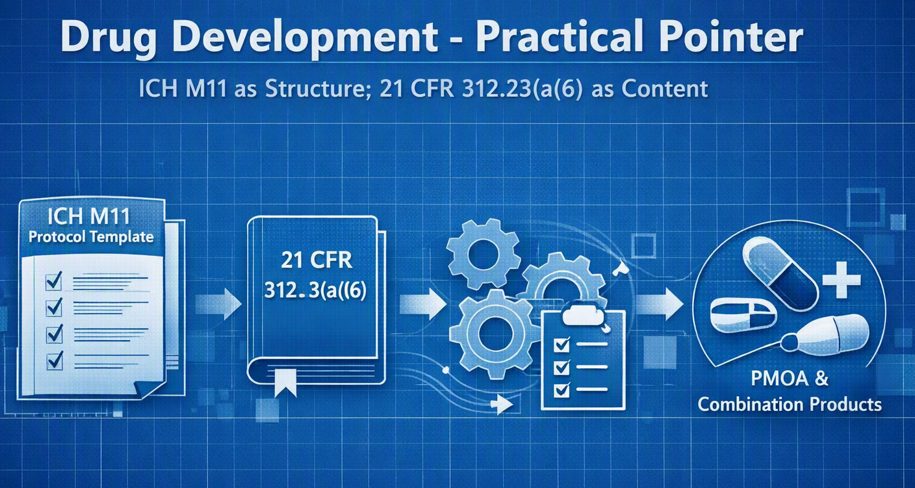
Practical Pointer: Use ICH M11 as the default protocol template but map it to regulatory content first. 21 CFR 312.23(a)(6)
The Point: The International Council for Harmonization of Technical Requirements for Pharmaceuticals for Human Use (ICH) M11 is now the first globally harmonized ICH standard for clinical trial protocol structure and electronic exchange. FDA issued the M11 guideline, template, and technical specification as final guidance in May 2026. M11 standardizes structure, numbering, and terminology, and supports machine-readable protocol elements that flow into downstream systems. However, because FDA requires content rather than a specific format, sponsors should map any protocol template to 21 CFR 312.23(a)(6) (for INDs) or 21 CFR 812.25 (for devices) to ensure completeness. M11’s scope is primarily medicinal-product trials, so device-led studies may require additional tailoring. For combination products, the primary mode of action (PMOA) guides the lead center and investigational pathway, and applicable requirements for each constituent part must be addressed. Where a single application is used, relevant constituent-part requirements should be incorporated as appropriate.
What to do:
· Map the template to the regulation: Before drafting, confirm that the protocol addresses every required element in 21 CFR 312.23(a)(6) (for Investigational New Drugs (INDs)) or 21 CFR 812.25 (for devices), including objectives, design, bias controls, dose and duration, assessments, and monitoring. M11 provides structure, but the regulation defines the obligation.
· Build critical‑to‑quality factors into the protocol and into the organization: ICH E6(R3) treats the protocol as the place where proportionate risk controls and critical‑to‑quality factors are designed in. But E6(R3) goes further: it expects quality to be built prospectively into trial design and conduct, with critical-to-quality factors identified early and their risks managed proportionately throughout the trial. The protocol template is a prompt, not a substitute for organizational behavior, training, governance, and ongoing risk management. So, sponsors must deliberately add these expectations to their templates and train all staff, so they are encoded in behaviors to avoid inconsistent or reactive quality practices later into the trial.
· Run SPIRIT 2025 as a final completeness cross-check: Standard Protocol Items: Recommendations for Interventional Trials (SPIRIT) 2025 is a reporting guideline, not a template, but it reliably catches gaps that templates miss, including harms assessment, patient involvement, and open-science items. The updated guideline (Chan, AW., Boutron, I., Hopewell, S. et al. SPIRIT 2025 statement: updated guideline for protocols of randomized trials. Nat Med 31, 1784–1792 (2025) https://doi.org/10.1038/s41591-025-03668-w) underscores the importance of documenting rationale and transparency for each protocol element. Use SPIRIT 2025 as a final completeness cross-check. When an item is not applicable, document that explicitly with a brief rationale to preserve reviewer navigation and demonstrate intentional completeness.
· Determine PMOA for combination products: For products with both drug and device characteristics, confirm the PMOA to determine whether the review will fall under the Center for Drug Evaluation Research (CDER), the Center for Biologics Evaluation and Research (CBER) or by the device center, the Center for Devices and Radiological Health (CDRH). PMOA guides the lead center, and requirements for the constituent parts should be incorporated as appropriate within a unified and filing package.
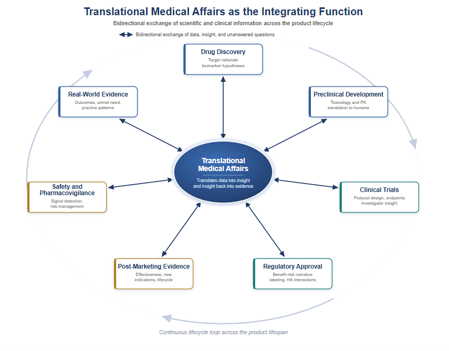
Translational Medical Affairs
Practical Pointer: Keep reactive off-label responses separate from proactive scientific exchange.
The Point: Medical affairs may respond to unsolicited off‑label questions, but firm‑initiated scientific exchange follows a different, stricter rule set. Compliance risk arises when the lanes blur, especially when a reactive question is converted into proactive communication or when off‑label content appears in promotional channels. The distinction is not about the science itself; it is about who initiated the conversation and where the information lives. The January 2025 Scientific Information on Unapproved Uses (SIUU) guidance as not yet for implementation pending OMB review, so these should be described as FDA recommendations and enforcement-policy considerations rather than requirements. In practice, the dividing line depends on initiation, audience/channel, evidentiary content, required or recommended disclosures, and clear separation from promotion.
What to do:
· Follow FDA rules for unsolicited requests: For reactive off‑label questions, answer only the specific question asked, respond privately to the requester, keep content truthful, balanced, and non‑promotional, and document both the request and the response. The 2011 FDA draft guidance remains the reference for this lane.
· Apply the 2025 guidance for proactive scientific exchange: Firm-initiated scientific information on unapproved uses should follow the principles outlined in FDA’s January 2025 SIUU guidance (document ending in 184871), recognizing that FDA currently treats this as enforcement-policy guidance pending OMB review. These communications should rely on scientifically sound publications, include recommended disclosures, and remain fully separate from promotional content in both substance and channel. Use dedicated webpages, emails, and meeting spaces so approved‑use promotion and unapproved use science are not conflated.
· Train Medical Affairs staff to maintain the firewall: Field staff must recognize unsolicited requests, avoid converting them into proactive discussions, and keep medical information response documents balanced and fully referenced. Most compliance failures arise not from possessing off‑label science, but from blurring who initiated the conversation and where the information is stored.
· Scientific Exchange Considerations: Some factors that should be considered to maintain the firewall between reactive medical information and proactive scientific exchange (to be approved by company management):
o Regulatory status: The use of [drug name] for [unapproved use] is NOT approved by the FDA.
o Clinical Status: The safety and efficacy of [drug name] for this indication has not been fully evaluated or established.
o Approved Use: [drug name] is indicated only for [insert approved indication].
o Purpose: This information is provided solely as a factual, balanced response to an unsolicited scientific inquiry. It does not constitute medical advice or a promotional recommendation. Please see the attached full [prescribing information / product labeling] for authorized usage guidelines.
o Tracking: Publications provided to covered recipients should be assessed for reportability under Open Payments requirements and company policy, rather than automatically reported for each healthcare professional.
o Scientific rigor expectations: For proactive SIUU communications, follow FDA’s recommended principles for evidence-based, non-promotional scientific exchange directed to an appropriate scientific audience, with disclosures consistent with the January 2025 SIUU guidance.