
Authors: Michael Fath, PhD1,2; Gerald L. Klein, MD2; L. Allen Kindman, MD2; Larry Florin, MBA2; Victoria Manax, MD2; Shabnam Vaezzadeh, MD1,2
Affiliations: Cavabio Consulting, LLC1; MedSurgPI, LLC2
The pharmaceutical landscape is witnessing a seismic shift, propelled by rapidly evolving waves of artificial intelligence (AI). AI’s impact on drug discovery and development has been extensively documented, and the implications for Medical Affairs are equally significant. This white paper examines the potential of AI to transform how MA professionals engage with healthcare professionals (HCPs), gather insights, and navigate the ever-evolving healthcare ecosystem.
Artificial Intelligence: What Is It and What Can It Do
AI is an extremely hot topic and nowadays has entered many business discussions as a key driver of future success. It is paramount to have clarity on what it entails and how it can be used.
In the simplest definition, AI is the science of creating machines that can think similarly to humans and process data in a quantity and speed beyond human capabilities. AI is projected to revolutionize our lives in ways that we cannot yet fully imagine.[1] AI has transformed many industries already, as its elements, such as reinforcement learning, supervised and unsupervised learning, computer vision, natural language processing and deep learning have been incorporated in different facets of our lives to varying degrees. Chatbots and predictive models have gradually become a routine part of systems interfaces.[2]
AI is predictive and single tasked as opposed to multitasking humans.[2] AI does have limitations and consequently human interface is required when utilizing the current AI tools such as ChatGPT.
Beyond Automation: Unveiling the Data Treasure Trove
Imagine being buried in a sea of data – clinical trial results, real-world evidence, competitor analysis, and mountains of scientific publications. This is the daily reality for many MA professionals. AI, however, can act as a powerful data interpreter, unearthing hidden patterns and correlations that can escape the human eye. Natural language processing (NLP) focuses on the interaction between computers and humans through natural language. In the context of medical affairs, NLP technology plays a crucial role in enhancing the efficiency, accuracy, and depth of various processes and research. This technology can sift through vast swathes of unstructured text, uncovering trends in HCP conversations, patient feedback, and social media discussions.[3] This real-time intelligence informs MA strategies, allowing for targeted interventions and proactive responses to emerging issues.[4]
Personalized HCP Engagement: From Routine to Resonance
Gone are the days of one-size-fits-all interactions. While not currently commonplace, AI powered chatbots can be developed to handle routine inquiries, freeing up valuable time for MSLs to engage in deeper, more strategic conversations.[5] Personalized content recommendations, tailored to individual HCP’s interests and practice areas, ensure relevant information reaches the right audience.[6] Sentiment analysis tools gauge HCPs' responses during interactions, allowing Medical Science Liaisons (MSLs) to adjust their approach and address specific concerns proactively.[7] This shift from information delivery to insightful dialogue builds trust and strengthens relationships, ultimately leading to better patient care, a key objective for medical affairs.[3]
From Insights to Impact: Optimizing Patient Care & Market Reach
AI's potential extends beyond HCP engagement, directly impacting patient care and market reach. Machine learning algorithms are being developed that can analyze patient data to predict potential adverse events, optimize medication regimens, and identify patients most likely to benefit from specific therapies.[8] This personalized approach has the potential to improve patient outcomes while reducing healthcare costs.[6] For market insights, AI analyzes competitor analysis, regulatory landscapes, and healthcare policy proposals, predicting future trends and identifying new market opportunities.[3] This forward-looking intelligence allows MA teams to adapt strategies and proactively engage with relevant stakeholders, a crucial aspect of market research.[5]
Challenges and Considerations: The Human Touch Remains Essential
Despite its promise, AI implementation in MA comes with its own set of challenges. Data quality and security are paramount, requiring robust infrastructure and ethical data governance practices.[4] Integration with existing systems and workflows can be complex, necessitating careful planning and training.6 However, the most crucial aspect remains the human element. AI should augment, not replace, the expertise and empathy of MSLs and medical advisors.5 The role of the medical affairs professional becomes more critical, focusing on the interpretation of AI-generated insights, building relationships, and providing human-to-human guidance.
The Future of MA: A Symbiotic Partnership
The future of MA lies in a synergistic partnership between human expertise and AI capabilities. By embracing AI, MA professionals can become more efficient, data-driven, and patient-centric, ultimately improving the value they bring to the healthcare ecosystem. This transformative journey requires ongoing investment in AI literacy, upskilling of MA teams, and a commitment to ethical and responsible AI implementation.3
AI Tools for MA
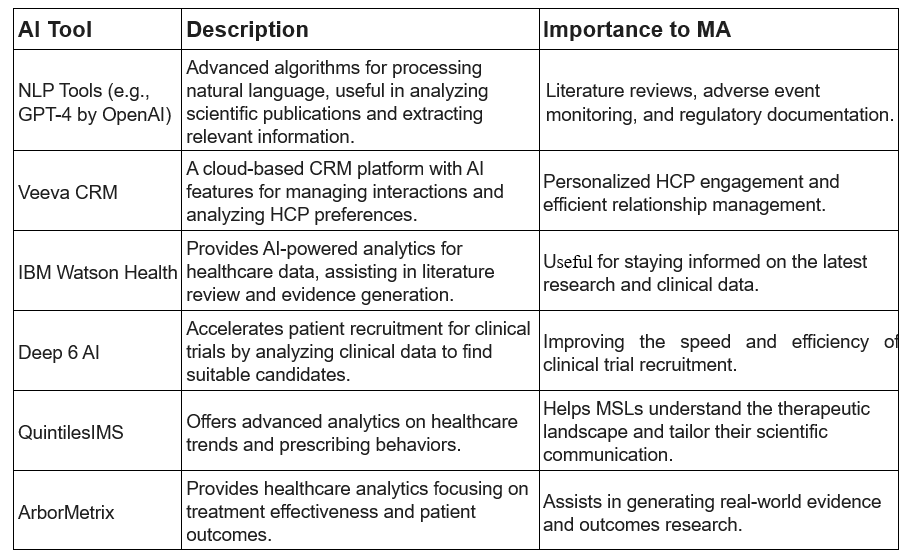
AI tools will be valuable in Medical Affairs so long as these tools support the critical responsibilities of MA while facilitating privacy and compliance aspects. Several Customer Relationship Management (CRM) tools are in the process of incorporating AI tools into their offerings. Stand-alone AI tools are also important options to be evaluated. Table 1 shows a partial list of some AI options.
Table 1
Embracing the AI Revolution:
With its potential to revolutionize HCP engagement, data analysis, and patient care, AI is poised to rewrite the script for Medical Affairs. By navigating its challenges and embracing its opportunities, MA teams can leverage this powerful technology to enhance their impact and drive better healthcare outcomes for patients. This is not just an evolution, it's an AI revolution, and MA professionals are at the forefront, navigating the data tsunami and leading the way toward a future where insights, not information, drive medical breakthroughs and improve lives.
References
1 HCLTech (2021). Artificial Intelligence, defined in simple terms (https://www.hcltech.com/blogs/artificial-intelligence-defined-simpleterms#:~:text=Artificial%20intelligence%20is%20the%20science,decisions%2C%20and%20judg e%20like%20humans).
2 World Economic Forum (2023). What is artificial intelligence – and what is it not? https://www.weforum.org/agenda/2023/03/what-is-artificial-intelligence-and-what-is-it-not-aimachine-learning/.
3 McKinsey & Company (2023). Unlocking the Value of Medical Affairs.
4 Blue Matter Consulting. Case Studies: AI in Medical Affairs.
5 THE MSL (2023). The Impact of AI on Medical Affairs.
6 Deloitte (2022). AI in Pharma and Life Sciences: Reimagining the Future of Healthcare. https://www2.deloitte.com/us/en/pages/life-sciences-and-health-care/articles/futureof-artificial-intelligence-in-health-care.html.
7 The Impact of AI on Medical Affairs (2022). A white paper by the Medical Affairs Professional Society. https://medicalaffairs.org/wp-content/uploads/2022/09/White-paper-AI-for-MedicalAffairs-rebranded.pdf.
8 Blue Matter Consulting (2021). AI in the Pharma Industry: Transforming Drug Discovery and Development.