
Authors: Gerald L. Klein, MD (1); Lee Schacter, PhD, MD (1); Larry Florin (2); Marion Stamp-Cole( 3); Patrick Loebs (1); Roger Morgan, MD (1); Emilia Jones Amaowei (4); Roger Nolan, PhD (1); Freddy Byrth (1)
Affiliations: MedSurgPI (1); LBF BioPharma Consulting (2); MSC Clinical Consulting (3); EJ MedInsights(4)
Drug Development
This paper examines how evolving FDA safety surveillance, data quality expectations, and participation challenges are reshaping clinical development and outlines the strategic role that Translational Medical Affairs (TMA) can play in addressing these shifts.
● The U.S. Food and Drug Administration launched the Adverse Event Monitoring System (AEMS) in March 2026 to “consolidate multiple disparate reporting systems currently used across all FDA-regulated product categories, including medical products, vaccines, devices, tobacco, food, cosmetics, and veterinary medicines.”[1] It is meant to do the following:
o Enhance data quality and consistency through standardized reporting protocols, streamline reporting processes to reduce administrative burden on both internal FDA staff and external stakeholders, and strengthen safety surveillance capabilities through advanced case processing workflows, AI-based redaction and digitization tools, enhanced analytics, and comprehensive cross-product surveillance.
o Serve as a centralized platform for consumer complaints, regulatory misconduct reports, and whistleblower submissions across all FDA centers.[2]
AEMS is also expected to enable convergence of traditionally distinct safety data streams, including solicited data collected in clinical trials and spontaneous post-marketing reports, thereby supporting a continuous, lifecycle-based safety surveillance framework from development through commercialization. In parallel, evolving expectations regarding “data fit for regulatory purpose” and the ongoing implementation of the International Council for Harmonisation of Technical Requirements for Pharmaceuticals for Human Use E19 guideline on selective safety data collection reflect a broader shift toward more targeted, risk-based data acquisition strategies. These developments align with the capabilities of AEMS, including the potential for near–real-time (e.g., daily) safety data ingestion and analysis early in the clinical development process.
● The U.S. Food and Drug Administration defines “data fit for regulatory purpose” as data that are relevant to the specific clinical and regulatory question and are sufficiently reliable, complete, and accurate to support regulatory decision-making; this concept is foundational to Quality by Design, requiring early identification and prospective incorporation of Critical to Quality (CtQ) factors to ensure data integrity from the outset of the study.[3] Clean data alone are not enough, data must also originate from fit-for-purpose endpoints and study designs aligned to the intended decision. If the data cannot directly support a regulatory or clinical decision, they are operationally costly, but strategically weak. Designing trials with decision-ready data in mind is now a competitive advantage. This raises several fundamental questions that should be addressed prospectively in study design:
o Is it relevant to the clinical and regulatory question?
o Is it reliable in how it was collected?
o Is it interpretable in the context of decision-making (regulatory, clinical, or reimbursement)?
o Is it free from systematic bias or adequately controlled to support valid inference?
● Participant enrollment and retention is directly proportional to clinical trial burden that is placed on these patients.[4] Enrollment and retention are influenced by a matrix of factors, including disease state and severity, the number and type of assessments (particular those that are invasive) and the evolving risk-benefit ratio as communicated to participants over the course of the study. Additional contributors include, among others, the travel distance, visit frequency and duration, procedural complexity, and the associated physical, psychological, and logistical burden (e.g., discomfort, time commitment) of study participation. This clinical trial burden in its entirety should be taken into consideration when estimating both the enrollment and retention rate of the study.
Translational Medical Affairs
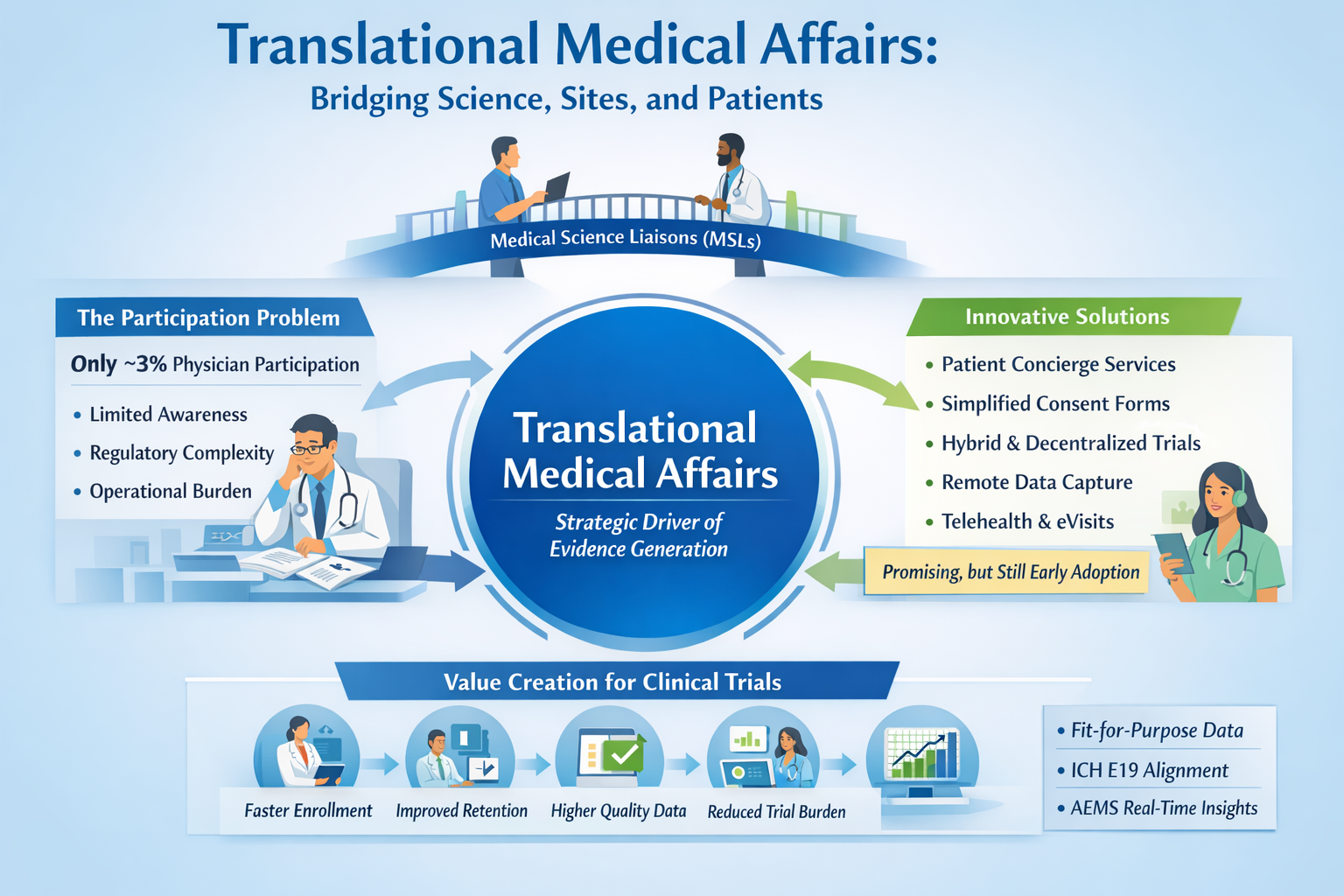
● It is estimated that only about 3% of physicians in the United States actively participate in clinical trials.[1] Limited awareness of opportunities, uncertainty regarding regulatory requirements, and the perceived operational burden of trial participation all contribute to low engagement. As a result, enrollment capacity becomes a structural constraint in clinical development. Efforts are underway to address these barriers to physician participation through practical solutions such as patient concierge services, simplification of study materials (including informed consent forms), hybrid and decentralized study designs incorporating remote patient data capture, and expanded use of telehealth; however, while promising, these approaches remain early in adoption and there is still a long way to go before they meaningfully resolve these structural challenges. In this context, Medical Science Liaisons (MSLs) are uniquely positioned to address the gap by reframing clinical trial participation as a scientific and institutional opportunity, rather than an operational burden, thereby enhancing physician engagement and supporting more efficient study execution. MSLs can strategically position participation by emphasizing the following value drivers:
o Contribute advancing standards of care
o Gain early access to innovative therapies
o Access academic and publication opportunities
o Strengthen institutional prestige and patient retention
o Increase practice revenue
o Drive professional growth and stimulation
● Translational Medical Affairs should play a more prominent role in scientific publication, as it operates at the critical interface between clinical practice, research, and real-world evidence generation. This unique positioning enables TMA to translate emerging data into clinically meaningful insights that advance patient care and inform clinical, payer, and policy decision-making. Publications provide a systematic capture and disseminate insights derived from clinical trials, investigator interactions, and real-world experience, areas that are often underrepresented in traditional academic outputs. Increased publishing strengthens scientific credibility, closes evidence gaps not addressed by registrational studies, and reinforces the non-promotional value as a trusted independent scientific partner.[2] Moreover, a robust publication strategy enhances engagement with key opinion leaders, contributes to guideline development, and elevates organizational visibility in an increasingly competitive and data-driven healthcare environment.
● Translational Medical Affairs can play an important role, as part of the interdisciplinary clinical development team, in early phase 2 trials by initiating early external engagement with key opinion leaders to validate assumptions, gather actionable feedback, and build scientific credibility. It also identifies evidence gaps that inform subsequent study design. This approach ensures that phase 2 programs remain scientifically robust, clinically relevant, and strategically aligned for later-phase success.[3] As clinical development becomes increasingly data-driven, patient-centric, and complex, TMA must evolve from a supportive function to a strategic driver of early evidence generation, leveraging proactive stakeholder engagement, identification of evidence gaps, and translational insight to shape development programs and de-risk later-phase outcomes.
In this context, evolving regulatory expectations around “data fit for regulatory purpose,” coupled with initiatives such as the International Council for Harmonisation of Technical Requirements for Pharmaceuticals for Human Use E19 guideline on selective safety data collection, further reinforce the need for targeted, high-quality data generation strategies. These trends align with emerging capabilities such as the FDA’s Adverse Event Monitoring System (AEMS), which is expected to support near–real-time safety data acquisition and to converge traditionally separate solicited clinical trial data and spontaneous post-marketing reports into a unified, lifecycle-based safety surveillance framework from development through commercialization.
[1] U.S. Food and Drug Administration. FDA Adverse Event Monitoring System (AEMS). Accessed March 31, 2026. https://www.fda.gov/drugs/surveillance/fda-adverse-event-monitoring-system-aems
[2] Ibid
[3] International Council for Harmonisation of Technical Requirements for Pharmaceuticals for Human Use (ICH). E6(R3) Guideline for Good Clinical Practice. Step 4. 2025. Accessed March 31, 2026. https://www.ich.org
[4] Unger JM, Cook E, Tai E, Bleyer A. The role of clinical trial participation in cancer research: barriers, evidence, and strategies. Am Soc Clin Oncol Educ Book. 2016;35:185–198.
[5] Henry TA. Trial-in-a-box to help more practices take part in clinical trials. American Medical Association. Published May 27, 2021. Available at: https://www.ama-assn.org/practice-management/digital-health/trial-box-help-more-practices-take-part-clinical-trials. Accessed March 31, 2026.
[6] Wager E, et al. Good publication practice for communicating company-sponsored medical research: GPP3. Ann Intern Med. 2015;163(6):461-464.
[7] Kaitin KI, DiMasi JA. Pharmaceutical innovation in the 21st century: new drug approvals in the first decade, 2000-2009. Clin Pharmacol Ther. 2011;89(2):183-188.