

Practical Pointers for Drug Development and Medical Affairs
November 2025
Authors: Gerald L. Klein, MD1; Roger E. Morgan, MD1; Melissa Palmer, MD2; Freddy Byrth1; Michael Fath, PhD3; Thomas Krol, MD1; Shabnam Vaezzadeh, MD4; Mark Tulchinskiy, MD5
Affiliations: MedSurgPI1; Liver Consulting, LLC2; Cavabio Consulting3; Exquisite Biomedical Consulting4; Worldwide Clinical Trials5
Drug Development
Improving Academic Research Site (ARS) or Academic Medical Center (AMC) Readiness for Industry-Sponsored Trials
Due to their access to specialized patient populations, multidisciplinary expertise, and advanced research infrastructure, academic institutions may have the opportunity to play a critical role in conducting clinical trials, particularly those involving rare diseases, underserved or vulnerable populations and complex study designs. However, an increasing number of academic sites are being excluded from industry-sponsored studies because of elevated institutional fees, excessive administrative complexity, and significant delays in executing required study documents, particularly lengthy IRB review and approval timelines.[1],[2] This problem is compounded by academic investigators who are not given protected time for their clinical investigator responsibilities and therefore lack the availability to meet with study clinical research associates (CRAs) or complete essential trial-related administrative duties. AMCs and ARSs can strengthen their participation and competitiveness in clinical research by:
o Allowing the use of central Institutional Review Boards (IRBs)
o Implementing a standardized clinical trial agreement format throughout the institution, ensuring its structure and key clauses reflect those commonly used by Clinical Research Organizations (CROs) and non-academic clinical research centers
o Setting reasonable budgets based on industry standards
o Allowing ARS/AMC medical investigators to have enough time to properly fulfill their clinical trial duties and responsibilities
By adopting these practices, institutions can reduce administrative costs and enhance their ability to attract and execute clinical trials.
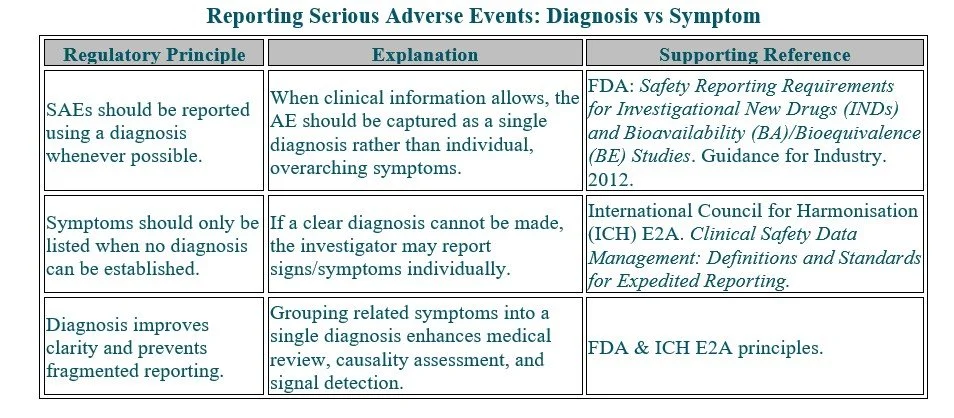
Serious Adverse Event (SAE) reporting may be complicated. Whenever possible, investigators should report a clinical diagnosis rather than individual symptoms, as diagnoses provide clearer context for safety assessment and regulatory reporting.[3] If additional SAEs or AEs occur during a hospitalization, these should be reported as separate AEs (e.g., if a hospitalized participant develops acute pneumonia or needs a blood transfusion for anemia that developed while hospitalized).
Ensuring Clear and Consistent Safety Reporting
ARSs and AMCs should apply a conservative, ethics-driven approach to safety reporting. These institutions can preserve their gold-standard ethical and scientific safety culture while materially improving speed, consistency, and data quality by standardizing attribution, professionalizing safety roles, and enforcing internal timeliness metrics. Regulatory timelines must be met.
Staying Current with Evolving FDA Guidance
The FDA and other regulatory bodies are constantly modifying by issuing new rules and guidelines. It is important to keep updated on these changes. One free easy-to-use source for this is the FDA website: https://www.fda.gov/drugs/guidances-drugs/newly-added-guidance-documents
Medical Affairs
Strengthening Academic and Clinical Partnerships
Affiliating with academic institutions offers a highly effective way to engage with key opinion leaders (KOLs) across diverse disciplines. Such collaboration may occur through adjunct and clinical faculty appointments, or by volunteering to contribute expertise to didactic teaching or clinical training activities.
Here are some of the methods that medical affairs professionals can pursue to demonstrate expertise in a scientific area:
o Roles at scientific meetings
§ Poster presentations
§ Serving on conference panels
§ Podium presentations
§ Serving on a panel discussion
o Scientific journals
§ Publish editorials and manuscripts
§ Serve as manuscript reviewers
§ Serve on journal editorial boards
o Academic institutions
§ Voluntary staff appointments
§ Other affiliations such as with prominent nonprofit research facilities, FDA, or Veterans Association Hospitals
§ Formal relationships, e.g., adjunct, or clinical faculty
Advancing Shared Goals through Collaboration
Collaborations between medical affairs and academic programs are essential for driving shared progress across the industry
o Facilitating coordinated responses to regulatory changes that support broad industry improvement
o Publicizing important safety concerns to protect patients and stakeholders
o Advancing the integration of emerging technology
o Enhancing healthcare outcomes by promoting innovative, evidence-based solutions for society
Developing medical diagnostic and therapeutic guidelines
o Creating objective cooperative work forces
§ Also done with scientific organizations
o Helping to design best practices
Establishing non-profit associations to promote a specific disease or patient population
o Providing time and materials can produce win-win results for all
[1] WCG 2024 Clinical Research Site Challenges Report
[2] Lai J, et al. Drivers of Start-Up Delays in Global Randomized Clinical Trials. Ther Innov Regul Sci. 2021;55(1):212–223.
[3] FDA: Safety Reporting Requirements for Investigational New Drugs (INDs) and Bioavailability (BA)/Bioequivalence (BE) Studies. Guidance for Industry. 2012.