

Authors: Gerald L. Klein, MD[1]; Freddy Byrth[1]; Roger E. Morgan, MD[1]; Michael Fath, PhD[2]; Patrick Loebs[1]; Shabnam Vaezzadeh, MD]3]; Larry Florin[4]; Kenny Carberry[5]; Eric Hacher[l], PhD6; Shengjun Zhang, MD[7]
Affiliations: MedSurgPI[1]; Cavabio Consulting[2]; Exquisite Biomedical Consulting[3]; LBF Biomedical Consulting[4]; Carberry Clinical Consulting[5]; SMART BioWorks, LLC[6]; BiotrialMed[7]
Drugs, Devices, and Diagnostics
Operational and regulatory takeaways for development teams
Drugs
Hospitals, universities, and other institutions remain a large, underutilized source of ideas for new therapeutic products.[1] These organizations should encourage entrepreneurial activity by providing education, training, and incentives that help staff identify inventions and innovations, develop intellectual property, and prepare commercially viable development plans. They should also strengthen educational links between academicians and industry professionals, enabling both groups to better understand the challenges and advantages of each environment and to bridge gaps that slow progress.
Conducting clinical trials is long, risky, and expensive. The time it takes many academic institutions to negotiate contracts and receive Institutional Review Board (IRB) approval is often excessive.[2] Regarding clinical trial agreements, institutions must standardize them across the institution. Consider operational fixes: using master CTA templates, fallback Intellectual Property (IP) terms, predefined startup-friendly license terms, and escalation timelines for contract impasse. Sponsors spend extra time adjusting to differing templates from one therapy area to the next within institutions, which exacerbates any review and revision time within the institution. This not only delays enrollment on the study but may shift sponsors and Contract Research Organizations (CROs) away from academics and more towards smaller, more agile centers. Standard agreements, such as Accelerated Clinical Trial Agreement (ACDA) and Accelerated Clinical Trial Agreement (ACTA) developed by major universities in collaboration with biopharma organizations and CROs have proven effective but remain underused. Likewise, use of the Streamlined, Multisite, Accelerated Resources for Trials Institutional Review Board (SMART IRB) Reliance model can reduce significant amounts of time associated with the IRB submission and approval process. Institutions should revise their technology transfer procedures to eliminate unnecessary bureaucracy and streamline operations. In particular, IP licensing or assignment terms should account for the financial and timeline risks that are being assumed by a startup entity intent on commercializing drug therapies. With current funding pressures, there is added urgency to adopt these efficiencies now. Doing so would increase productivity and strengthen collaboration between industry and academia.
Let us know your thoughts: info@medsurgpi.com
Devices
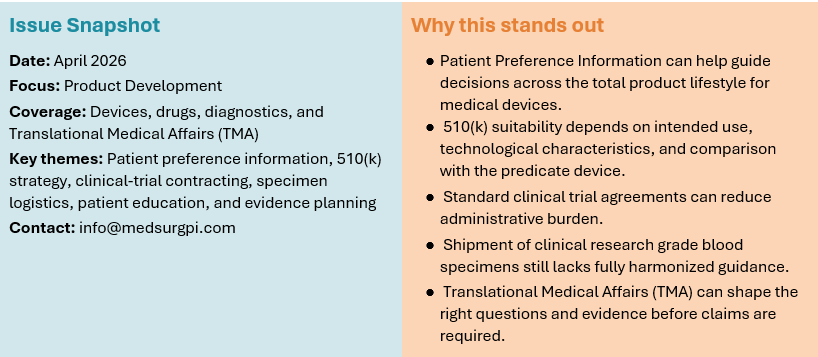
FDA’s March 2026 final guidance on Patient Preference Information (PPI) can be useful across the total product lifecycle for certain devices in several major ways, including:[1]
● Identifying unmet device needs and potential treatment options
● Determining endpoint prioritization or selection
● Determining effectiveness targets for clinical studies
● Informing clinically meaningful change in an endpoint
● Helping identify the most important benefits and risks from a patient’s and caregiver’s perspective
● Assessing the relative importance to patients of different benefit-risk attributes
● Clarifying how patients think about tradeoffs between benefits and risks
● Understanding heterogeneity in patient preferences, including subgroup considerations for benefit-risk assessments.[2]
How to know if your new device fits a 510(k) pathway
Start with the predicate-device question:
● Is there an FDA-cleared predicate device[3] with:
The same intended use, and
The same technological characteristics, or different ones that do not raise new questions of safety or effectiveness?
o A 501(k) is not merely a predicate search exercise. The sponsor must support substantial
equivalence with performance data when technical differences exist.
Ways to answer this include:
● Searching the FDA 510(k) database.
● Searching the classification database to see how FDA classifies similar devices.
● Submitting a briefing package through the FDA Pre-Submission (Pre-Sub/Q-Sub) program.[4] The FDA will respond in writing. This step should be grounded in a clear understanding of the numerous FDA and European Medicines Agency’s role within the EU Medical Device Regulation (EMA-MDR) guidance documents and directives that shape device development, including the critical requirement for a robust Quality Management System.
● Submitting a request for designation under 513(g). While this pathway provides a binding FDA determination of a product’s regulatory classification, it offers limited opportunity for dialogue or relationship-building with the Agency. For that reason, it is generally less advantageous than engaging through the Q-Sub process, which supports interactive feedback and more collaborative communication.[5]
Diagnostics
One of the biggest challenges in shipping blood specimens to central laboratories during clinical trials is temperature excursions and mechanical stress that cause sample degradation.[6],[7] A 2019 study found that 10% of red blood cell samples fell outside standard ranges, underscoring how vulnerable specimens are during transport.[8] Unfortunately, no harmonized guidelines exist for clinical-research-grade shipments.
Relevant resources include:
● WHO guidelines on the safety of shipping blood, and
● International Council for Standardization in Haematology (ICSH) materials, which address SOPs for specific analyses.
● Instructions from individual central laboratories, including validated packaging and handling requirements
Any labs or individuals with experience are invited to comment at info@medsurgpi.com.
Translational Medical Affairs (TMA)
Where medical insight becomes momentum: from first concept to lasting market impact
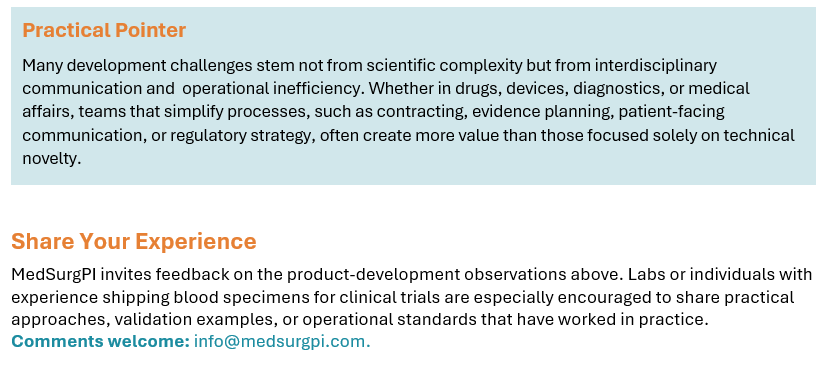
Patient education and training, and their understanding of how the pharmaceutical product relates to their individual health factors, are evolving rapidly. A patient’s and caregiver’s grasp of the importance and relevance of a treatment is essential for medication adherence. Written, audio, and video materials when combined with provider explanation, all contribute to better outcomes, especially when countering misinformation from unreliable online sources.[9]
Translational Medical Affairs (TMA) serves as the scientific bridge between early research, clinical development, and real-world medical practice, ensuring that insights from each stage inform the others.[10] Early engagement with clinicians and other health care professionals through TMA can surface questions about drug interactions, clinical benefits, and potential risks. Having this type of data in advance allows teams to frame answers and position the drug appropriately.[11]
Indications and claims for an approved drug depend entirely on the questions asked, endpoints selected, and data generated during clinical trials. This is often underappreciated. It is therefore critical that TMA help shape the right questions early so the development program yields the evidence needed for future regulator permitted claims.[12]
[1] Food and Drug Administration. Incorporating Voluntary Patient Preference Information Over the Total Product Life Cycle: Guidance for Industry, Food and Drug Administration Staff, and Other Interested Parties. March 2026. Published March 27, 2026. Accessed April 27, 2026.
[2] U.S. Food and Drug Administration. Patient Preference Information - Voluntary Submission, Review in PMAs, HDE Applications, and De Novo Requests, and Inclusion in Device Labeling. Guidance for Industry, Food and Drug Administration Staff, and Other Stakeholders. 2023.
[3] US Food and Drug Administration. The 510(k) Program: Evaluating Substantial Equivalence in Premarket Notifications [510(k)]. Guidance for Industry and Food and Drug Administration Staff. FDA; July 28, 2014. Accessed April 27, 2026. Available at: https://www.fda.gov/regulatory-information/search-fda-guidance-documents/510k-program-evaluating-substantial-equivalence-premarket-notifications-510k
[4] Food and Drug Administration. Final Guidance on Incorporating Voluntary Patient Preference Information Over the Total Product Life Cycle. FDA Bulletin. March 27, 2026.
[5] Food and Drug Administration. How to Write a Request for Designation (RFD): Guidance for Industry. April 2011. Accessed May 7, 2026. FDA‑2011‑D‑0214.
[6] World Health Organization. Blood Cold Chain. WHO; 2011.
[7] International Council for Standardization in Haematology (ICSH). ICSH Recommendations for the Standardization of Haematology Review: Pre-analytical Variables and Sample Handling. Int J Lab Hematol. 2019;41(S1):1-29. doi:10.1111/ijlh.13011.
[8] Aalaei S, Amini S, Keramati MR, Shahraki H, Eslami S. Monitoring of Storage and Transportation Temperature Conditions in Red Blood Cell Units: A Cross-Sectional Study. Indian J Hematol Blood Transfus. 2019;35(2):304-312. doi:10.1007/s12288-018-1038-6
[9] Institute for Safe Medication Practices. Best Practices for Patient Education. ISMP; 2023.
[10] Klein G, Loebs P, Byrth F, Schacter L, Fath M. Translational Medical Affairs (TMA): A New Operating Model Bridging Preclinical Science, Clinical Development, and Real‑World Impact. SSRN. Published April 24, 2026. Accessed May 7, 2026. https://papers.ssrn.com/sol3/papers.cfm?abstract_id=6640018
[11] American Medical Association. Principles of Translational Medical Affairs. AMA; 2022.
[12] US Food and Drug Administration. Labeling for Human Prescription Drug and Biological Products—Content and Format; Guidance for Industry. FDA; 2013.
[1] Kinch MS, Horn C, Kraft Z, Schwartz T. Rising academic contributions to drug development: evidence of vigor or trauma? ACS Pharmacol Transl Sci.
[2] Lawrence CE, Bruce V (Nickie) M, Salberg LD, et al. Quantitative assessment of the impact of standard agreement templates on multisite clinical trial start up time. Journal of Clinical and Translational Science. 2023;7(1):e204. doi:10.1017/cts.2023.622