

Authors: Gerald L. Klein, MD1; Michael Fath, PhD1,2; Freddy Byrth, BA1; Lee Schacter, PhD, MD1; Emilia Jones Amaowei1,3; Patrick Loebs, MSW/MPH1; Roger Morgan, MD1
Affiliations: MedSurgPI1; Cavabio Consulting2; EJ MedInsights3
Guidance for Research Safety and Regulatory Reporting
This edition focuses on how to recognize and report an unanticipated problem, how to assess expectedness, and which reporting duties may apply in parallel.
Regulatory
Recognizing and Reporting Unanticipated Problems
In guidance for nonexempt research conducted or supported by the U.S. Department of Health and Human Services (HHS), the Office for Human Research Protections (OHRP) applies three criteria to an unanticipated problem involving risks to subjects or others:
· Unexpected: Its nature, severity, or frequency goes beyond the risks described in study documents and relevant product information, considering participant characteristics.
· Related or possibly related: Research participation could reasonably have caused or contributed to it.
· Greater risk: It reveals more potential harm than previously recognized, including physical, psychological, economic, or social harm.1
All three criteria must be met. A confidentiality breach may qualify without an adverse event (AE). Follow the applicable Institutional Review Board (IRB) reporting policy; for a breach involving protected health information, also assess Health Insurance Portability and Accountability Act (HIPAA) breach-notification obligations.2,1,3
Drug Expectedness Is a Separate Assessment
· OHRP unanticipated problems: Whether a research incident is an unanticipated problem under OHRP is a different question from whether an event is expected for Investigational New Drug (IND) safety reporting. For research procedures, the OHRP assessment considers the protocol, consent materials, participant characteristics, and the circumstances of the event, not the Investigator’s Brochure (IB) alone.1
· FDA IND safety reporting: For IND safety reporting purposes, the IB serves as the reference safety information for expected drug reactions. An event is expected only if the IB lists it at the specificity and severity observed. Events anticipated because of the underlying disease or study population remain unexpected unless included in the IB. Being unexpected alone does not make an event reportable; an IND safety report also requires that the event be serious and that there be evidence suggesting a causal relationship to the drug.4,5
· European Union (EU) clinical trials: In the EU, expectedness is assessed against the reference safety information (RSI): the list of expected serious adverse reactions used for expectedness assessment, distinct from the IB’s broader safety discussion. For an unauthorized investigational product, the RSI is a clearly identified IB section; for a product authorized in the European Union / European Economic Area (EU/EEA) and used according to its marketing authorization, Section 4.8 of the Summary of Product Characteristics (SmPC) may serve as the RSI.6
· Informed consent: Newly identified risks may require informed consent form (ICF) revisions and notification of enrolled participants about findings that could affect their participation. Consider whether the new information changes what participants need to know and whether renewed consent is appropriate.7
Example: A Retained Needle Fragment
A needle fragment retained after a research injection is a potential device- or procedure-related complication and a potentially reportable unanticipated problem. Assess the protocol, consent materials, participant characteristics, and circumstances of the event to determine whether it is unexpected, related to the research procedure, and suggests greater risk than previously recognized; all three criteria must be met.1 Arrange prompt clinical assessment; the treating clinician determines whether imaging or removal is necessary. Assess serious adverse event (SAE) criteria separately, including inpatient hospitalization or intervention needed to prevent a serious outcome.4
The investigator assesses and reports; the IRB reviews the classification and protections required. Sponsor safety review addresses the event’s implications across the study.2,4,8
Reporting Duties May Apply in Parallel
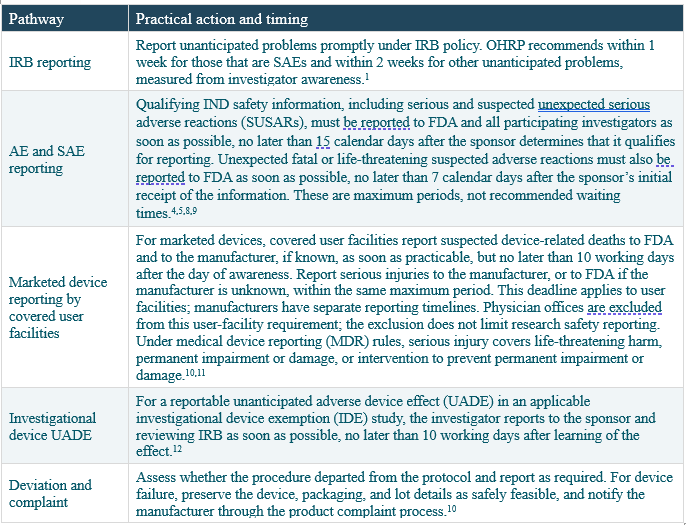
Apply each pathway only when its own criteria are met.
OHRP also recommends onward institutional and agency reporting, including OHRP where applicable, within 1 month of IRB receipt. These are recommendations; applicable requirements and IRB deadlines govern.1

References
Regulations and online sources accessed October 8, 2026.
1. Office for Human Research Protections. Reviewing and Reporting Unanticipated Problems Involving Risks to Subjects or Others and Adverse Events. January 15, 2007. Sections I–V. Nonbinding guidance for applicable HHS research. OHRP guidance.
2. IRB functions and operations. 21 CFR §56.108(a)(4), (b). Expedited review procedures. 21 CFR §56.110(b). Section 56.108 | Section 56.110.
3. Notification in the case of breach of unsecured protected health information. 45 CFR §§164.400–164.414. Current regulations.
4. IND safety reporting. 21 CFR §312.32(a), (c). Includes SAE definitions and sponsor reporting criteria. Current regulation.
5. US Food and Drug Administration. Sponsor Responsibilities—Safety Reporting Requirements and Safety Assessment for IND and Bioavailability/Bioequivalence Studies. Guidance for Industry. December 2025. FDA final guidance.
6. European Commission. Clinical Trials Regulation (EU) No 536/2014 Questions & Answers. EudraLex Volume 10, Version 7.3. July 2026. Chapter 7, Q&A 7.8–7.9. CTAG guidance.
7. Elements of informed consent. 21 CFR §50.25(b)(5); 45 CFR §46.116(c)(5). Current regulations.
8. Investigator reports and assurance of IRB review. 21 CFR §312.64(b) and §312.66. Section 312.64 | Section 312.66.
9. US Food and Drug Administration. Investigator Responsibilities—Safety Reporting for Investigational Drugs and Devices. Guidance for Investigators, Industry, and Institutional Review Boards. December 2025. Docket FDA-2021-D-0368.
10. US Food and Drug Administration. Mandatory Reporting Requirements: Manufacturers, Importers and Device User Facilities. See user facility reporting requirements and complaint reporting. FDA reporting requirements.
11. Medical device reporting definitions and user facility requirements. 21 CFR §803.3 and §803.30(a). Section 803.3 | Section 803.30.
12. Investigational device exemptions. 21 CFR §812.3(s) and §812.150(a)(1). UADE definition and investigator reports. Section 812.3 | Section 812.150.