
Authors: Lee Schacter, PhD, MD and Gerald L. Klein, MD
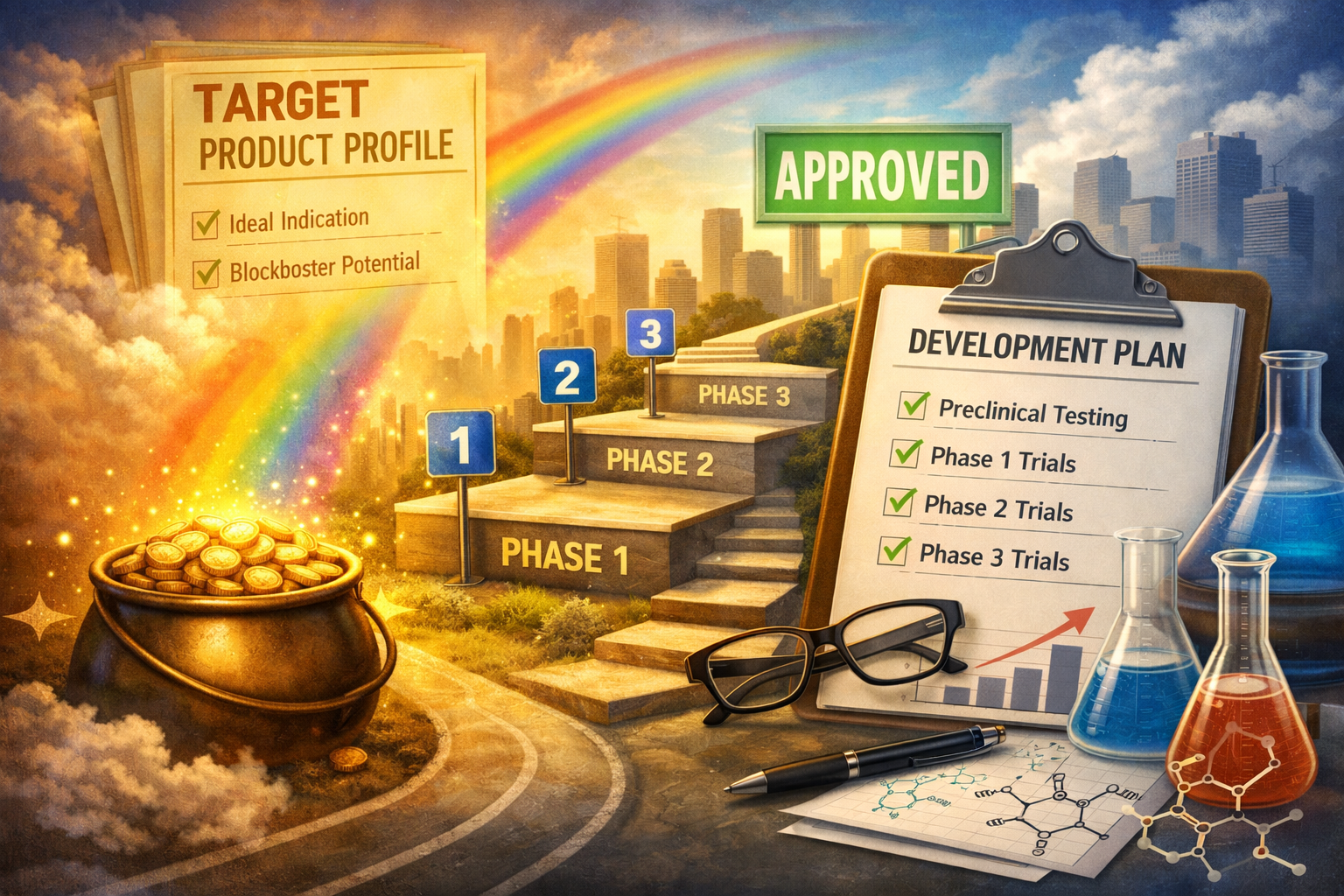
The development of a new chemical entity is guided by two documents; the Target Product Profile and the Development Plan. The first is a wish list, the second, a road map to those wishes and the pot of gold that awaits if they are achieved.
Whether it is a new compound “tossed over the fence” from discovery to clinical in Big Pharma or the precious creation of a biotechnology company, the challenge for the clinical group is to turn a chemical entity into a marketable product.
Step one is the wish list. If the new compound, which we will call FRED, works as well as possible based on preclinical models, what is the ideal labeled indication for use that can be approved? For example, if FRED has been designed to treat rheumatoid arthritis, the dream label could read “FRED is indicated for the initial treatment of rheumatoid arthritis in adult and pediatric patients.” But not all dreams come true and sometimes it is necessary to accept a second or third place finish such as “FRED is approved for the treatment of rheumatoid arthritis in adults after the failure of initial therapy” or even worse; “FRED is approved for the treatment of adults with rheumatoid arthritis refractory to all other available modalities.”
Now the “game is afoot.” Will management be flexible with the label? Is the worst possible label acceptable to management? Will it represent an adequate return on investment to justify further development? What if the worst possible label is first to market for a new class of agents and there is an opportunity to expand the label? What compounds, if any, with the same mechanism of action are in development, and at what stage? How will FRED be positioned? What will be its therapeutic niche? Will it be first-in-class agent, the best-in-class among similar compounds, or a me-too product, perhaps differentiated only by a more favorable pharmacokinetic profile that supports a lower price point? All these factors and more (Table 1) have to be considered in the Target Product Profile.
Table 1
Considerations for the Target Product Profile
Expected clinical activity
Therapeutic needs (current and projected) the product can address
Comparisons to existing agents; strengths, weaknesses, opportunities, and threats (SWOT analysis)
Route of delivery vs. existing agents
Cost of goods
Overall competitive environment including marketed products and those in development
The Development Plan takes the Target Product Profile for FRED and creates a path to making dreams come true. This plan is based on the science behind the new agent, the treatment options currently available for the target disease, along with those in development, and the projected cost of development. The Development Plan should represent the “value proposition” for FRED. While it aims to account for both the current and future competitive environment for FRED, it must remain a living document, modified as new data for both FRED and for other agents, both approved and in development, become available.
A major consideration is cost and time in development. New drug development spending is stratospheric. A recent paper[1] concludes “that the median… total R&D expense, reflecting all clinical trials and including adjustments for inflation, capitalization, and discontinued products, was approximately …. $708 million” in 2019. They also note that “…costs captured by patient-months comprise most total … R&D spending….” Similar findings were reported elsewhere, estimating that “the mean cost of the clinical phase per drug candidate was $117.4 million”, with approximately $27 million for phase 1, $34 million for phase 2, and $38 million for phase 3.[2]
Faced with these costs and the success rate of new compounds (approximately 10-20%)[3,4] the development plan has to be focused on the rapid efficient evaluation of any new compound. This requires carefully crafted go/no go criteria at each stage of clinical trials along with timelines that are aggressive but achievable. The endpoints must also be chosen to support the earliest possible registration.
Critical elements therefore include:
Define the regulatory strategy for the US, EU, and other territories
o Determine if the compound will be developed as a first-in-class, best-in-class, or “me too” agent and where it will fit in the treatment paradigm of the target disease
Meet with regulatory authorities to discuss the proposed development and registration strategy, obtain feedback on the registration pathway, and align the clinical and nonclinical development program with regulatory requirements and expectations. Define the data needed for go/no go decisions for each stage of development (phases 1-3).
o In a competitive environment for patients and investigators, design studies need to be attractive to both by minimizing patient and site burden, and by keeping protocols focused and as simple as possible.
Avoid scientific side shows or academic curiosities that are of interest but not on the critical path to regulatory approval while collecting essential data for next generation drugs.
Track therapeutic landscape in the target disease including compounds in development and emerging relevant science.
———————————————————————
[1] Mulcahy AW, et al. Use of Clinical Trial Characteristics to Estimate Costs of New Drug Development. JAMA Network Open. 2025;8:e24533275. doi:10.1001/jamanetworkopen.2024.53275
[2] Setkaya A, et al. Costs of drug development and research and development intensity in the US, 2000–2018. JAMA Network Open. 2024;7:e2415445. doi:10.1001/jamanetworkopen.2024.15445
[3] Yamaguchi S, et al. Success rates of new compound development. Clin Transl Sci. 2021;14(3):1113-1122. doi:10.1111/cts.12978
[4] Duxin S, et. al. Why 90% of clinical drug development fails and how to improve it? Acta Pharma Sin B 2022; 12(7): 3039-3062